From§Each

MONDAY, 21 SEPTEMBER 2026 — THE MATINEE EDITION

Entertainment

Page D1

Man vowing to save his name on Kennedy Center photographed holding plans titled 'Kennedy Center DEMOLITION.'
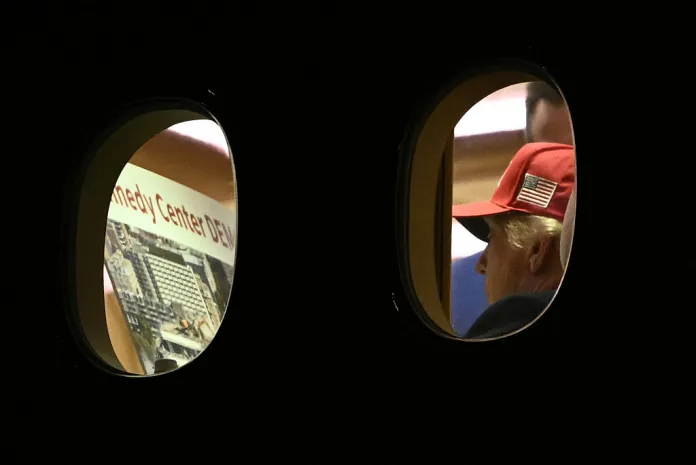
Trump seen reading plans for Kennedy Center ‘DEMOLITION’ during ride on Air Force One (Photo via Washington Examiner)

"The renovation" died Wednesday night, somewhere over open water, at the age of three weeks. Cause of death: a photograph.

It was born August 26, when this administration told CBS News that if the courts kept blocking the president's push to put his name on the John F. Kennedy Center for the Performing Arts, demolition might follow the renovation plans anyway — a threat, we were assured at the time, contingent on the lawyers. The very next day, Commerce Secretary Howard Lutnick floated a gentler path: skip the court fight, just let the Center "acknowledge" the president for his role in the renovations. Two offers on the table, one day apart — keep the name through construction, or lose the building entirely. Both, notably, still required a name to attach to something left standing.

On August 29, Rep. Joyce Beatty, an ex officio board member who has already beaten back one round of the administration's proposed changes in court, said the litigation might yet stand between the wrecking ball and the building. "Who's going to stop them?" she asked, and answered her own question with a lawsuit.

Wednesday night settled it a different way. A photographer working outside the plane caught the president aboard Air Force One, reading a placard through the little window. Not a renovation schedule. Not a naming-rights memo. A placard that said, in full, "Kennedy Center DEMOLITION" — no name on it anywhere, no contingency, no if-the-courts-allow. Three weeks of conditional grammar, gone in one exposure. The building did not get an "if."

Preceded in death, then, by the renovation, which turns out never to have been a separate thing from the demolition — just its outdoor voice, its public-facing nickname. Survived by the lawsuit, by Beatty's seat on the board, and by a public that spent three weeks arguing over whose name goes on a building whose own blueprint already had a different word printed across it.

That is malarkey dressed up as urban planning, and I do not say so lightly at my age. The whippersnappers in this trade like to call it messaging. I call it a placard on a plane, photographed sideways through glass nobody remembered to cover.

In lieu of flowers, the administration might simply release the demolition filing itself — the real one, not the one glimpsed at an angle through aircraft window — so the public can read plainly what the president was already reading.

Continued on Page D2

Billionaire accused of ousting Macklemore over 'free Palestine' offers him $2 million and a sit-down.

Robert Kraft wants to sit down with Macklemore. That request comes three days behind the message that actually moved the rapper: notice from Ed Sheeran's tour that he was off The Loop's remaining U.S. dates, after telling a crowd to free Palestine. Macklemore didn't guess at why. He posted on Instagram that Kraft and other stadium owners had pushed the removal. The Hill ran it. So did Truthout and the Daily Caller, same week, same allegation: a pressure campaign, then the dates disappeared.

Macklemore didn't need the argument to be complicated to make his point. "I didn't need 10 shows from Ed," he said. "I needed 2." Then he pledged his full $1 million in tour earnings to Palestinian relief organizations. He'd lost the shows. He kept the number, then gave it away.

Three days after that Instagram post, Fox News reported Kraft's own number. Ed Sheeran, Kraft said, had phoned him personally; his response was a $2 million humanitarian pledge — twice what Macklemore gave, revealed the same week the New York Post reported Kraft wanted that sit-down. Fox's own headline captured the split screen: Kraft's pledge landed "as Macklemore faces fallout over venue ban" — the fallout that same billionaire's side stands accused of creating. Macklemore, the Post noted, has not responded.

Line the events up in the order the wires filed them and the mechanism is not subtle. A man says two words onstage. Stadium owners, Kraft among them by his own accuser's account, get him pulled from the tour. He pledges a million dollars for a job he no longer holds. The man accused of costing him that job writes a check twice that size three days later. The allegation went unrebutted on the record. The bigger number became the answer.

Kraft didn't need the sit-down to happen for it to work. Fox News already ran his number. The New York Post already ran his request. Macklemore still hasn't responded. The $2 million pledge doesn't need him to.

Continued on Page D2

After 30 years on the bench, Judge Judy retires and appoints her son her successor.

Judge Judy, a program, died last week in syndication after thirty years on the bench, the family confirmed at a party held to mark the occasion. She was born in 1996, daughter of daytime television and small-claims court, and lived to see twenty-five seasons of her own docket before handing down her final verdict on "Judy Justice" this October.

The cause was retirement, announced without incident on September 12, when Sheindlin, then 83, revealed the show would end and that she would remain, as ever, employed in the entertainment business. Two days later, on September 14, the succession was made official: her son, Adam Levy, premiered "Adam's Law" in national syndication, telling reporters he had "learned from the best." He did not run for the gavel. It was handed to him.

By the time the party marking the exit closed out this week, the arrangement had the shape of the family businesses this page usually covers under other names: an owner steps back, an heir steps forward, and the enterprise itself never actually leaves the household. Nobody auditioned. Nobody had to. The bench was, it turns out, a chair, and chairs can be willed.

Judge Judy is survived by "Adam's Law," which inherits not just her gavel but her format, her tone, and, by Levy's own account, her method. She is preceded in death by Judge Wapner, whose "People's Court" opened the courtroom to cameras a generation earlier and asked nothing of blood.

There is no scandal to dig up here, no penny-ante grift behind the curtain — a mother built a program, her son learned the trade at her elbow, and a network looked at thirty years of ratings and decided the safe move was continuity. That is not malarkey. That is just how a hit gets kept in the family, same as a Senate seat or a car dealership, and the audience is not expected to notice the difference. It is a shit way to run a search committee, but nobody convened one.

In lieu of flowers, the next time an institution announces its "next generation" is ready, ask who else auditioned for the job.

Continued on Page D2

HOSTAGE TAKING

Trump-picked board votes to close Kennedy Center, fences it off, faces hearing demand on own vote.

They vote to shut the doors themselves, fence off the entrance themselves, then a sitting congresswoman has to beg a judge for a hearing on a decision the board already made without her. That's not a safety closure, that's a stall on a nameplate fight — the ceiling collapse hurt zero visitors, but the fence went up faster than any repair crew showed. Watch how fast "closed for renovations" turns into whichever name ends up back on the building when the doors reopen.

Continued on Page D3

Sheeran drops Macklemore for saying Palestine, watches the bill quit, says he's not complicit

A guy says two words on a stage, gets his name pulled off a tour by a billionaire who then brags about doing it — that's not a booking decision, that's a bill collector for a war showing his badge. Then the whole opening lineup quits one by one and Sheeran stands up and says "I'm not complicit" like the sentence does the work the exits already undid. The math doesn't care how it feels to say it out loud.

Continued on Page D2

Fashion council president gags protester on camera, Daily Caller calls it a fed-up exec's reality check

By Sunday night the story had already settled into two separate objects that happen to be the same five seconds of tape. NBC News reported it plainly: the president of the Council of Fashion Designers of America was captured on video grabbing an animal rights protester at New York Fashion Week and covering her mouth with his hand. That is the whole incident, stated once, correctly.

The Daily Caller reported it differently. Their headline: "PETA Protestor Crashes NYFW Show, Gets Reality Check From Fed Up Fashion Exec." A reality check. Delivered by a man described, in their own copy, as fed up — which is doing a great deal of work for a word that usually means annoyed, not a hand over someone's mouth.

And here the defense has to be made, so it will be made. He was provoked. A show was disrupted. Executives are not obligated to stand still while their industry is interrupted, and a firm hand — a firm hand covering a woman's mouth on camera, that's — that's not a reality check, that's the incident NBC already described, just relabeled by a headline writer who watched the same tape and reached for a gentler verb.

The Daily Caller's own body text does not stop at "fed up." It goes further than NBC did: he pinned her on the floor with his legs. Not held her back. Not escorted her out. Pinned, floor, legs — offered by the outlet defending him, as if the detail helped the case. It does not help the case. It is the case.

So the talking point has to be that context matters, that protesters accept certain risks when they crash a show, that fashion has a right to protect its runway — and that's true as far as it goes, except it doesn't go anywhere near covering someone's mouth with your hand while your legs hold her to the floor. That's not risk. That's the video. The one outlet reported. The other one renamed.

Two headlines, one clip, and the gap between them is the entire story: what one network calls an assault, another calls a correction, and the only difference is which side of the runway you're standing on when the hand goes over the mouth.

Continued on Page D2

South Park renames itself to mock a move Apple and Google already made real.

An executive order works on a lake the way a memo works on a company: it does not touch the water, it touches the label. On August 27th the President signed one renaming Lake Ontario "Lake America," a parting shot after trade talks with Canada broke down. The lake stayed exactly where it has been for centuries, half in New York and half in Ontario. The order was never really about geography. It was about which name the software would carry.

Google went first. By Saturday, two days after the signature, Google Maps showed "Lake America" to users in the United States. Apple took longer: its maps didn't catch up until September 1st, five days after the order, trailing Google by three days. The gap is the whole story in miniature — two of the largest companies on earth changed the name of a lake for the government that regulates them, and even they couldn't agree on how fast to do it.

Ontario didn't wait on either app. On August 29th, Premier Doug Ford put up a large sign reading "Lake Ontario" and left it standing. It's not much of a rebuttal to an executive order, except that a sign doesn't take software updates. That's the whole appeal of a road sign in a fight like this one.

By September 1st, the same week Apple fell in line, a Reuters/Ipsos poll had the count: 63 percent of Americans opposed the renaming. A majority said no in the same stretch of days two of the country's biggest tech companies said yes. The order didn't need the public's permission. It needed the map's, and the map said yes twice, at two different speeds.

Which is what makes South Park's move this week almost redundant. Trey Parker and Matt Stone announced the show will rename itself "South America," crediting the "bravery and patriotism" of Apple and Google for the inspiration. It lands as satire because it's staged as one — a title card, a press line, a joke everyone's in on. But strip the delivery and it's the same act Google performed on a Saturday without one: change the name because the change came from above. The cartoon needed a punchline to do what the map did as routine maintenance.

Line up the dates — the order, the map, the sign, the poll, the cartoon — and only one of them was trying to be funny.

Continued on Page D2

Mar-a-Lago claims no knowledge banning the singer Florida Republicans already banned for the same joke.

Let's be clear about what happened, because the coverage is getting ahead of the facts. A source says organizers of the Mar-a-Lago law enforcement fundraiser had no knowledge of Jelly Roll's jokes about the president when they pulled his invitation. No knowledge. That's the statement, that's what we're standing behind, and frankly the timeline supports it if you don't look at the timeline.\n\nHere's what actually happened, in order, because order matters here. On August 27, Rep. Jimmy Patronis, a Florida Republican, told the press that Jelly Roll -- born Jason DeFord -- was no longer welcome in his Panhandle district. Why? Because of a Kimmel monologue where the singer made fun of the president's weight. A sitting congressman, on the record, naming the singer, naming the jokes, twelve days before Mar-a-Lago's own event. Twelve days. That's the number. I want to be precise about that number.\n\nThe next day, Jelly Roll went back on Kimmel and explained himself -- said he's "down the middle," said watching a fight on TV doesn't mean he supports the administration. Same day, a separate item has him walking back his apolitical stance entirely, saying he plans to vote this November. So within twenty-four hours you've got a congressman disowning him and the singer politically radioactive enough to make news twice for the same monologue.

By September 4, Fox News is running a piece asking whether Jelly Roll just Bud Lighted himself -- the story notes his monologue "mirrors Bud Light's brand-destroying misstep," fan backlash and all. That's four days before the Mar-a-Lago fundraiser reportedly decided he wasn't welcome there either.

So walk it with me: congressman disowns him by name over the jokes, singer responds publicly, singer gets compared in the trade press to the last celebrity who tanked a brand this way, and then -- twelve days after the congressman's statement -- a law enforcement fundraiser at the president's own club uninvites him over the identical jokes and says, through a source, that organizers didn't know.

Didn't know what? The congressman's name was in the story. The singer's name was in the story. The jokes were the same jokes.

Okay. I'm not saying anybody's lying. I'm saying the paper trail runs twelve days deep and it has the same name in it every time, and "no knowledge" is a phrase, and phrases don't have to survive contact with a calendar to get printed. They just have to get printed.

Continued on Page D2

King Charles's letter confirms Harry and Meghan remain non-working, worth $680 million.

Let the record show: King Charles's office did exactly what a functioning institution does when a story gets confused. It wrote a letter. On September 7, the Palace confirmed, again, that Prince Harry and his wife, Meghan, remain non-working members of the royal family — a status unchanged since 2020, restated now because the couple has moved back to the United Kingdom and someone needed it in writing. This is called clarity. A confused public gets a document, and the document says the same thing it has always said. Nothing to see here, which is presumably why it had to be said again.

The first pressure to say it came August 28, when a Washington Examiner column ran the title alongside a figure, tallying the returned couple's household against what it called Britain's $680 million royal lie. That's a columnist's number, not a government one. The letter is about titles. The $680 million is about money, which the letter does not mention, because the letter is about titles. Did I already make that argument? I believe I already made that argument.

Three days after that column, on August 31, Queen Camilla had Harry to tea at Highgrove ahead of the move the letter now formalizes, offering what one report described as a "fixed smile" — the sort of expression a family produces when logistics require it, not when reconciliation does. Then on September 4, the logistics turned domestic: warning letters went out to parents at the Cotswolds school where Archie and Lilibet are starting classes, over privacy rules that, per the experts quoted, the family still cannot control. That one isn't about titles either. That one is about who stands outside a school gate with a camera. I'm not confident the letter covers that.

Which leaves the letter answering exactly one of the three things it was released into: not the $680 million, not the school, just the title. Non-working is doing one job in Monday's sentence. $680 million is doing a very different one. The Palace answered the question it wanted asked, in writing this time.

Continued on Page D2

Trust in authorship is dying: colleges doubt your essay, artists sue over their stolen voice.

OBITUARY. The presumption of authorship — the working assumption, held for as long as anyone alive can remember, that the person whose name sat atop an essay or a song had, in fact, made the thing — died this week. It was old enough that nobody thought to check its age. It is survived by a great deal of paperwork.

Born sometime before anyone bothered writing it down, the presumption served two institutions faithfully for generations: the college admissions office, which took your essay at your word, and the record industry, which took your melody at your word. It asked for very little in return. Trust, mostly, and the occasional benefit of the doubt.

It began to fail this year in colleges first. Admissions officers, per this week's reporting, no longer trust that the application in front of them was written by the applicant rather than assembled by a large language model, and grade inflation upstream hasn't helped them sort out who's telling the truth. The essay, once a decent proxy for a seventeen-year-old's mind, became a coin flip.

It failed a second time in music. Jason Isbell and a group of fellow artists filed suit against Suno, an AI company accused of generating music built on their work without so much as a byline, let alone a check. If the presumption of authorship were still alive, that would have been a contract negotiation. Instead it was a lawsuit, because there was no longer a shared assumption to negotiate from.

A related notion — the idea that meritocracy itself measures anything real once a machine can produce the application and, apparently, the song — is now in critical condition and not expected to recover soon, according to this week's commentary.

Preceded in death by: the take-home essay, the benefit of the doubt, several assumptions about who actually wrote your kid's personal statement.

Survived by: two lawsuits, one admissions office running background checks on grammar, and a great deal of malarkey about what a machine can and cannot be credited with.

In lieu of flowers, the family asks that any institution still capable of verifying authorship — a school, a court, a copyright office — actually do it, before there's nothing left to check.

Continued on Page B2

Taylor Swift and Travis Kelce debut their new dog as Alaska’s ranked-choice voting puts longshots on ballot

The news offers Taylor Swift and Travis Kelce’s new dog a debut, while Alaska’s ranked-choice voting opens the door for unlikely candidates. The mechanism is the same: the crowd decides who gets the spotlight, but the outcome isn’t always the expected one. The primetime slot goes to whoever brings the numbers, whether it’s a pop star’s puppy or a ballot underdog. The walk from the red carpet to the voting booth is shorter than it looks. The stakes are the same—who gets attention, who gets a shot, and who gets written off as a longshot. In both cases, the crowd’s choice is the headline, not the result. The underdog gets their moment, but the system makes sure the spotlight stays on the show, not the stakes.

Continued on Page A2

The Marquee · in their own words

Who stands where, billed strictly by the number of documented political acts on their record. The credit in parentheses is how you know them; the links are the receipts.

Center Stage

Names the public assigns a side the record does not support — the quote is the correction.

“Qanon and the entire MAGA movement was a grift. I'm disgusted at how the CYA Conservatives/GOP has left 75,000,000 voters hanging out to dry. I'm done with politics & I never trusted either party. So long Patriots!”
— Isaiah Washington (Grey's Anatomy), Twitter, 2021
“My agents and my managers all left me.”
— Antonio Sabato Jr. (General Hospital), Variety, on the cost of his 2016 RNC speech, 2020
“a registered independent with a lot of libertarian leanings”
— Tom Selleck (Magnum, P.I.), National Review, 2004
“Politically, for me to speak on it, there are experts who know much more than I do.”
— Kevin James (The King of Queens), Fox News, 2026
“The amount of people struggling out there because of these f***ing billionaires, and they got us all arguing liberal and conservative.”
— Bill Burr (F Is for Family), Monday Morning Podcast, 2025
“It feels to me like it's a genocide that's happening while we're alive here in front of our, in front of our lives.”
— Theo Von (This Past Weekend), This Past Weekend podcast, 2025
“Actually, there was supposed to be an Epstein joke here, but I guess it got deleted. Probably deleted itself, right? Probably never existed, actually. Let's move on as a country and ignore that.”
— Shane Gillis (Kill Tony / SNL), ESPY Awards monologue, 2025
“I know there's heartbreaking stuff that's been happening right now, but I want this night to be an escape and I think that's why I was brought on.”
— Nate Bargatze (The Tennessee Kid), Entertainment Weekly interview, 2025
“When you jump into that political realm you're alienating some of your audience.”
— Kevin Hart (Jumanji), Variety interview, 2017
“I just keep my head down and make sure the jokes are funny. We hit both sides equally, and we try to make everybody laugh, and that's really the way our show works.”
— Jimmy Fallon (The Tonight Show), CNBC interview, 2025
“I will always be an American before I am a Republican. That's why, this week, I am voting for Kamala Harris and Tim Walz.”
— Arnold Schwarzenegger (The Terminator), Written endorsement posted to his social media, 2024
“I'm going to keep my politics to myself, and I think it's between me and the ballot box.”
— Dwayne Johnson (Jumanji), Esquire Summer 2026 cover interview, 2026
“The question is not, 'Did your candidate win or lose?' but rather, 'Will you wake up the next morning and help an old lady move?'”
— Chris Pratt (Guardians of the Galaxy), Op-ed in Maria Shriver's Sunday Paper, 2024
“A lot of celebrities did, do, and shouldn't.”
— Mark Wahlberg (Ted), Task & Purpose interview, 2016
“I've lived my life being angry, which is what I was on Fox News. I was the angry, conservative Black woman and at that time in my life, it was who I was. I realized in 2016 that anger is unsustainable and it will destroy you. I made a lot of mistakes because of that anger.”
— Stacey Dash (Clueless), DailyMailTV interview, 2021
“Whether your road leads you to Pete, like mine has, that's for you to judge.”
— Kevin Costner (Yellowstone), Buttigieg rally, Indianola, Iowa, 2019
“The only candidate I ever supported is Ron Paul.”
— Vince Vaughn (Wedding Crashers), Los Angeles Times interview, 2020
“I couldn't say, 'I'm a Republican, sorry.' I wasn't a Republican, I was worse: I was a hardcore libertarian.”
— Kurt Russell (Escape from New York), The Daily Beast, 2015
“I love my country, but at this time, I don't recognize my country.”
— Angelina Jolie (Maleficent), Press conference, San Sebastián International Film Festival, 2025
“It is also a path that I am choosing not to take at this moment.”
— Matthew McConaughey (Dazed and Confused), Video statement declining the Texas governor's race, 2021

Billing order is arithmetic, not adjective: rank is the count of sourced acts — office held, campaign staffed, convention stage, rally, endorsement — and one receipt bills at the bottom. Both columns get the same knife. Living actors only; every line links or it does not run. Roster verified 23 August 2026; the record moves, and so does the bill.

The entertainment archive — every headline the section has run